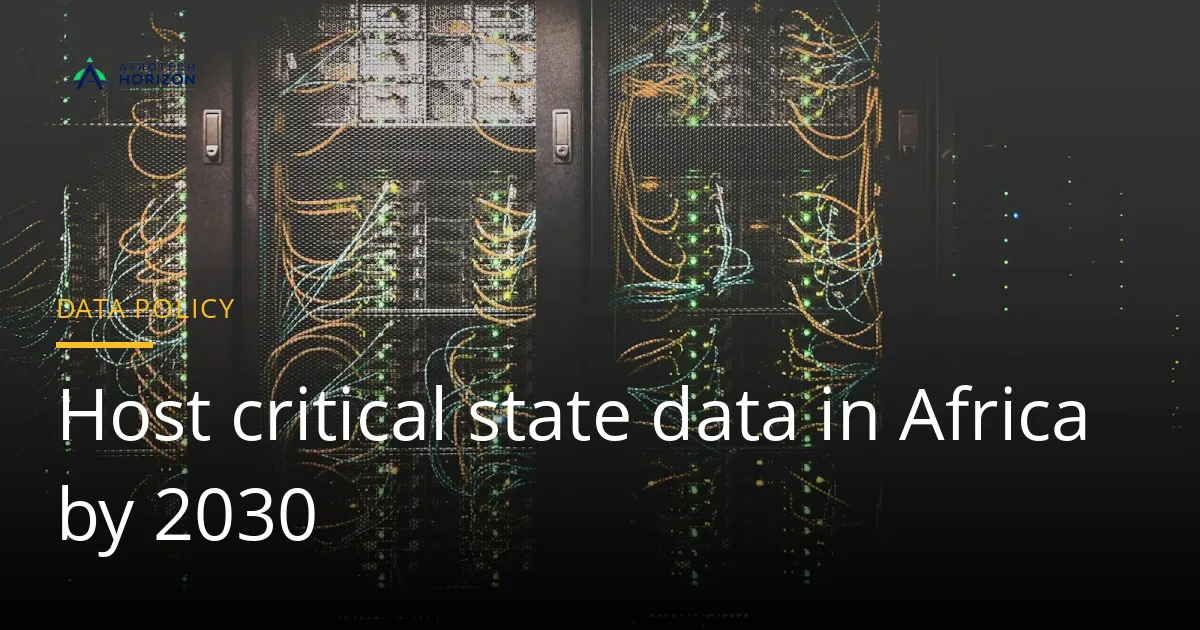
African governments have been asked to keep every piece of their classified critical or sovereign data inside their own borders by 2030. The target sits in the Yaoundé Declaration on E-Governance and Artificial Intelligence in Africa, adopted on 17 October at the close of the E-Gov'A conference in Cameroon's capital, according to Business in Cameroon. For data centre operators and cloud providers, government data hosting at that scale would be a large new market.
The declaration is a recommendation, not a law. But if ministries act on it, it could redirect public IT budgets towards local and regional facilities and away from servers in Europe and the United States.
What the Yaoundé Declaration asks for on government data hosting
The text, as reported by Business in Cameroon reporter Ludovic Amara, sets out a simple order of preference that it calls "Local First, African First":
- Host critical government data in the country that owns it.
- Where local capacity is not enough, and the type of data allows it, use a facility in another African country.
- Prefer both of those over providers that store data outside the continent.
It also encourages public and private investment in data centres, computing capacity, cloud services and shared regional infrastructure. Governments and organisations that endorse it are invited to name up to three measurable commitments before the next edition of the conference.
A new observatory
The declaration creates an African Observatory for E-Government and Artificial Intelligence. Its secretariat will be run jointly by Smart Click Africa and Digital Business Africa, the two organisers of E-Gov'A. It is meant to publish an annual report, build an African barometer of e-governance and AI, and map digital public services and the infrastructure behind them.
What is missing
The report is clear about the gaps, and they are large:
- No investment figure. Nobody has said how much data African governments hold, where it sits today or how sensitive it is, so the cost of moving it home cannot be estimated.
- No country timelines. There is no funding allocation or national schedule for new facilities, including for Cameroon itself.
- No procurement pipeline. In a communication dated 21 October, the organisers had not presented tenders or investment plans.
- No definition of "critical". Each country would have to decide which categories of data must stay at home and under what conditions providers can manage it.
That last point carries legal weight. Cameroon's personal data protection law, adopted on 23 December 2024, governs personal data and its transfer abroad. Much state data, such as procurement files, budget systems or land records, is administrative rather than personal, so existing privacy rules would not cover everything the declaration has in mind.
Who could gain
If governments follow through, the obvious winners are operators with facilities already on the ground. In Cameroon, state operator Camtel runs a data centre at Zamengoé near Yaoundé, and ST Digital runs one in Douala that serves both companies and public agencies. Whether either has the capacity for a nationwide requirement is not established.
Across the region, the "African First" clause could also help larger hubs in Nigeria, Kenya and South Africa sell capacity to smaller neighbours. But a declaration does not award contracts. Revenue depends on ministries classifying their data, setting hosting budgets and writing technical standards for providers.
Why it matters now
Two trends make the timing notable. Governments are adding AI tools to public services, which means more sensitive data flowing to cloud platforms. And African states are already taxing and regulating foreign digital services more closely; Ghana's banks, for example, now add a 20% charge to Netflix, ChatGPT and cloud bills, as we reported in our piece on the Ghana digital services tax.
Local hosting is not the same as good hosting. A government server room with weak security, unreliable power or no backups can be riskier than a well-run foreign cloud. The real test for the Yaoundé target will be whether countries pair it with standards for uptime, encryption and audits, and with the electricity to keep the racks running.
What to watch
- Which governments formally endorse the declaration and what three commitments they name.
- Whether Cameroon publishes a data classification framework or hosting tender.
- The observatory's first annual report and barometer.
Source: Business in Cameroon, 23 October 2026.