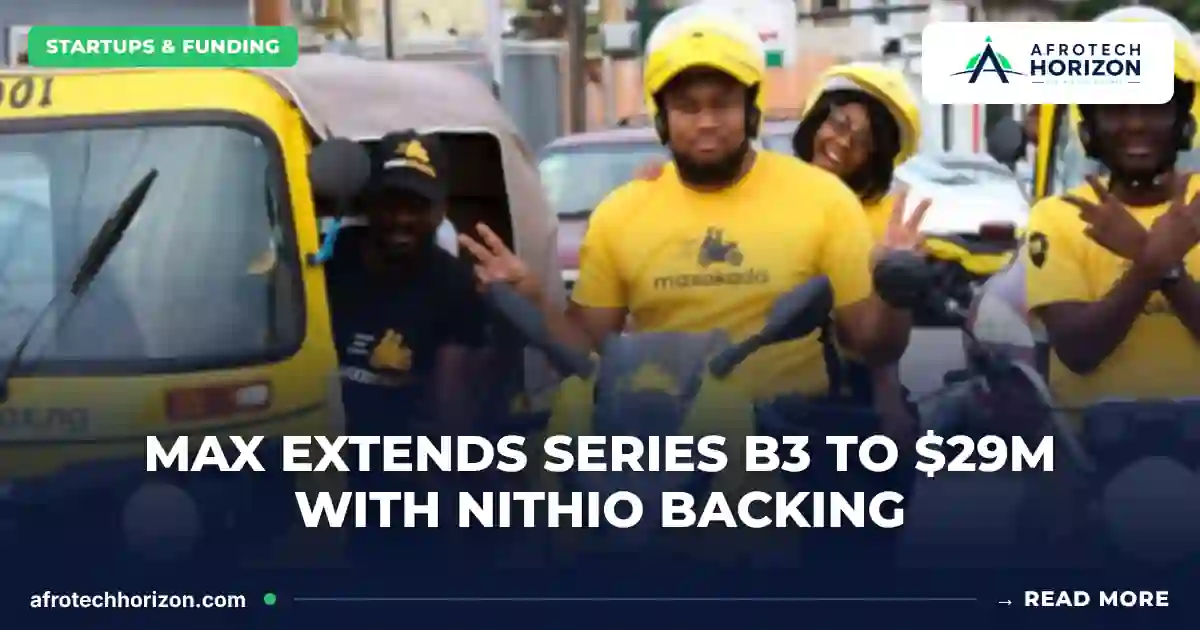
Nigerian electric mobility company MAX has extended its MAX Series B3 round to $29 million after an investment from Nithio, a US climate fintech. The amount Nithio put in was not disclosed. The deal builds on the $24 million equity and debt round MAX announced in January 2026, according to Justina Salami at The Condia, and it comes with a claim that matters more than the headline figure: MAX says it is now profitable in Nigeria, its largest market.
Profitability is rare in African mobility, a sector that has burned through large amounts of venture money on bikes, buses and ride-hailing. MAX's numbers suggest that financing vehicles for working drivers, rather than running a ride-hailing app, may be the part of the business that pays.
What the MAX Series B3 extension involves
Here is what has been reported about the round so far:
- Round size: the Series B3 now stands at $29 million, as reported by WeeTracker and The Condia.
- New investor: Nithio, a US climate fintech. Its cheque size was not disclosed.
- Earlier money: a $24 million equity and debt round in January 2026.
- Nithio's Africa record: this is its second investment in an African mobility company. The first was Spiro's $7 million debt raise.
Raghav Sachdeva, Nithio's chief investment officer, said MAX combines technology, financing and operations to help transport operators acquire productive assets. MAX chief executive Adetayo Bamiduro said the deal validates a model that is "clean, affordable, and pays for itself."
How MAX makes money
Bamiduro and Chinedu Azodoh launched MAX in 2015 as a bike-hailing startup. The company has since turned into an electric vehicle and battery subscription platform for commercial drivers.
The daily-fee model
Drivers pay a daily fee with no upfront cost. That fee covers the vehicle, insurance, maintenance and training. FollowICT's summary of the deal adds that MAX bundles EV financing, battery swapping, digital payments and fleet management for transport operators. For a motorcycle or tricycle rider who cannot get a bank loan, a pay-as-you-earn plan is often the only realistic way to own a vehicle.
The repayment record
MAX says it has deployed more than $56 million in fleet financing and has had $44 million repaid. Those figures are the company's own and have not been independently audited in the reports we reviewed. If they hold up, they point to a loan book that is performing, which is what lenders like Nithio look for before committing more capital.
Scale across three countries
MAX operates in 20 cities across Nigeria, Ghana and Cameroon. The company reports:
- more than 60,000 drivers and commercial transport operators served;
- over one billion trips facilitated;
- an estimated 238,000 tonnes of greenhouse gas emissions avoided, according to WeeTracker.
Its targets for 2027 are ambitious: support for 250,000 drivers and annual recurring revenue above $150 million. Reaching that would mean roughly quadrupling the driver base in about a year, which will need a lot more financing capital than this round provides.
Why investors are backing EV asset finance now
The round lands in a difficult funding climate. Nigerian startup funding fell sharply in September, as we reported in our look at why Nigerian startup funding dropped 97%. Yet asset-backed businesses have kept raising money, often in the form of debt rather than equity.
The logic is simple. A motorcycle or battery can be repossessed and redeployed, so lenders can price the risk. Climate-focused funds also count avoided emissions as part of their returns. MAX sits where both of those interests meet, which helps explain why a specialist like Nithio is returning to the sector after its Spiro deal.
The same week, other mobility and energy companies on the continent raised capital too. FollowICT reported that Bisedge secured about $11.2 million in debt from Finnfund for electric forklifts, and that NeoFleet Capital raised $4 million to finance taxi fleets in Senegal and Côte d'Ivoire.
What to watch
Three questions will shape how the rest of the MAX Series B3 story plays out:
- Ghana and Cameroon economics. MAX says it is profitable in Nigeria. It has not said the same about its other two markets.
- Battery infrastructure. Battery swapping needs reliable power. Grid problems in parts of Nigeria and Cameroon raise costs for any EV operator.
- Funding mix. Getting to 250,000 drivers will likely require far more debt. The terms MAX secures will decide how much of each daily fee ends up as profit.
For drivers in Lagos, Accra or Douala, the practical question is whether MAX's daily fee leaves enough room to earn a living after payment. Its repayment figures suggest that, for many, it has so far.