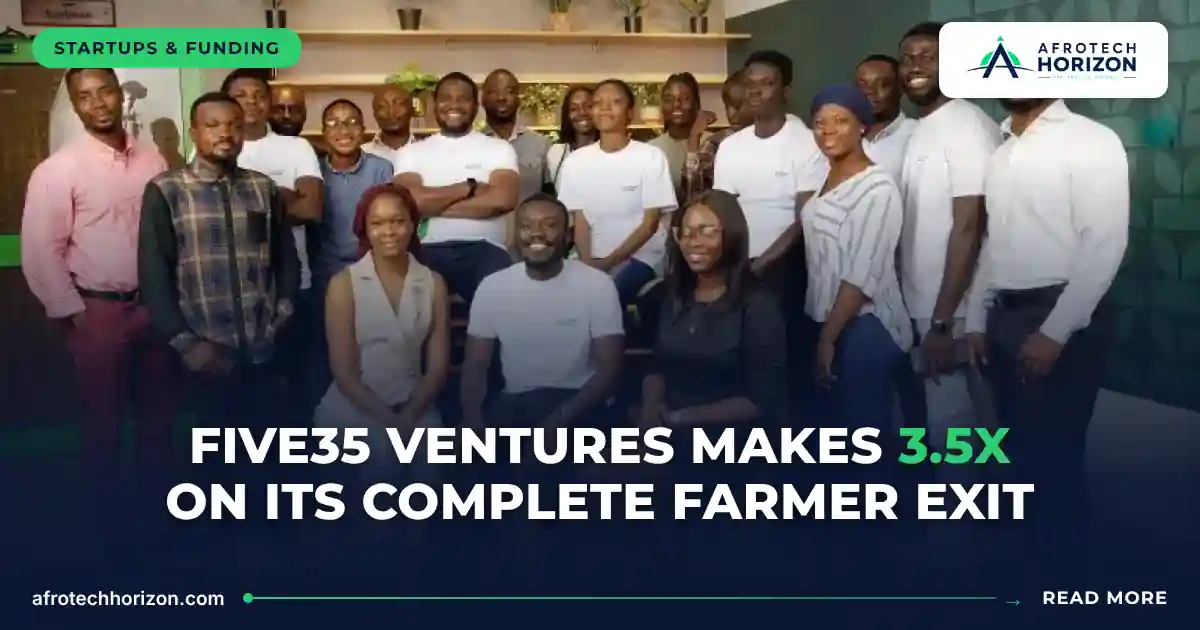
Five35 Ventures, an Africa-focused venture capital firm that invests with a gender lens, has made 3.5 times its money on its first exit. The firm sold its stake in Ghanaian agritech company Complete Farmer in March 2026, almost four years after it first invested in April 2022.
The deal returned a 3.5x multiple on invested capital (MOIC) and a 38% internal rate of return (IRR), according to figures Five35 shared with Daba Finance and other outlets. TechCabal covered the deal on 19 October. Neither the buyer nor the size of the cheque has been made public.
How the Five35 Ventures exit worked
Five35 left through a secondary transaction, according to The Innovation Spark's StartupGhana newsletter. In a secondary sale, an investor sells its shares to another investor. The company does not list on a stock exchange and is not bought outright, and Complete Farmer keeps operating as an independent business.
That route matters in Africa. Initial public offerings by tech companies are rare, and trade sales to larger firms are still uncommon. For many early backers, selling to a later-stage investor is the most realistic way to turn paper gains into cash before a fund's life runs out.
Complete Farmer's valuation rose from $6 million when Five35 invested to $49 million at exit, Innovation Village reported. That is roughly an eightfold increase, while Five35's own return was 3.5x. A gap like that usually comes from dilution in later funding rounds or from a discount on the secondary sale. Five35 has not said which applied here.
What Complete Farmer does
Complete Farmer was founded in 2017 by its chief executive, Desmond Koney. The company links smallholder farmers with buyers, inputs, agronomy support and finance. Commercial and institutional buyers use the platform to source crops directly from vetted producers.
By the time Five35 exited, Complete Farmer had served 12,628 business customers and created 77 direct jobs. The company says it works with more than 72,000 farmers across eight regions of Ghana, runs eight fulfilment centres and has operations in Togo.
The company is still raising money. In September, the International Finance Corporation (IFC) gave it a $2.4 million convertible loan through the Business Investment Financing Track, plus $660,000 in advisory and grant support. A US securities filing cited by Innovation Village shows its Delaware parent, CompleteFarmer Technologies, Inc., had raised $9.2 million from six accredited investors toward a $12 million target.
"Too many farmers with the capacity to grow commercially still struggle to access the financing they need to do so," Koney said when the IFC deal was announced. The company aims to connect 240,000 smallholder farmers with lenders by 2030.
The gender numbers behind the deal
Five35 is backed by the Mastercard Foundation Africa Growth Fund. The Growth Fund is a $200 million fund-of-funds that invests in African-led, women-led investment firms rather than directly in startups. Five35 looks at how women take part in and benefit from a business, whether as staff, suppliers, customers or farmers in its supply chain.
When Five35 invested, women made up:
- 55% of Complete Farmer's farmer network
- 80% of its post-harvest workforce
- 43% of its core team
By exit, women held half of the company's board seats.
"At Five35, we look for businesses in which commercial growth and inclusive impact reinforce one another," said Hema Vallabh, General Partner at Five35 Ventures. She called the result "an important validation of our investment strategy" and said gender-lens investing "is not a concessionary strategy" but a disciplined way to find overlooked markets.
Why a 3.5x return matters for African VC
A 3.5x multiple will not make headlines in Silicon Valley. In African venture capital, it carries more weight than the number suggests.
Most African funds are still early in their lives, and many have raised money on the promise of returns they have not yet shown. Even the basic funding numbers are disputed, as our look at how differently trackers count African startup funding shows. Limited partners such as development finance institutions and foundations want proof that money can come back out of the market, not just go in.
A realised 38% IRR on a Ghanaian agritech company is that kind of proof. It came from a sector many investors avoid, through a women-led fund backed by a fund-of-funds created to test exactly this model. It also came from a sale to another investor, a route many African funds will have to rely on.
Lessons for founders
Complete Farmer's case shows that early investors can be paid out without the company being sold. Founders who plan for secondary sales, and keep their records and governance ready for new shareholders, give early backers a way out and can bring in fresh capital at the same time.
Its mix of funding is another lesson. Equity, a convertible loan from the IFC, debt from Symbiosis and blended capital from the EU's AgriFI programme have all sat on its balance sheet. For a business that finances farmers, that mix may suit better than equity alone.
Lessons for funds
For fund managers, the takeaway is about timing. Five35 sold after about four years instead of waiting for a larger exit that might never come. The return is modest by global standards, but it is cash in hand, and it gives the firm a track record to show its next investors.
Five35 has not said how much it invested or who bought its shares. Until African funds publish more of these details, each disclosed exit will be judged on a handful of headline numbers. This one is a good start.